
Field Notes
I keep catching myself doing something that would have sounded ridiculous a few years ago.
I do not open the app first.
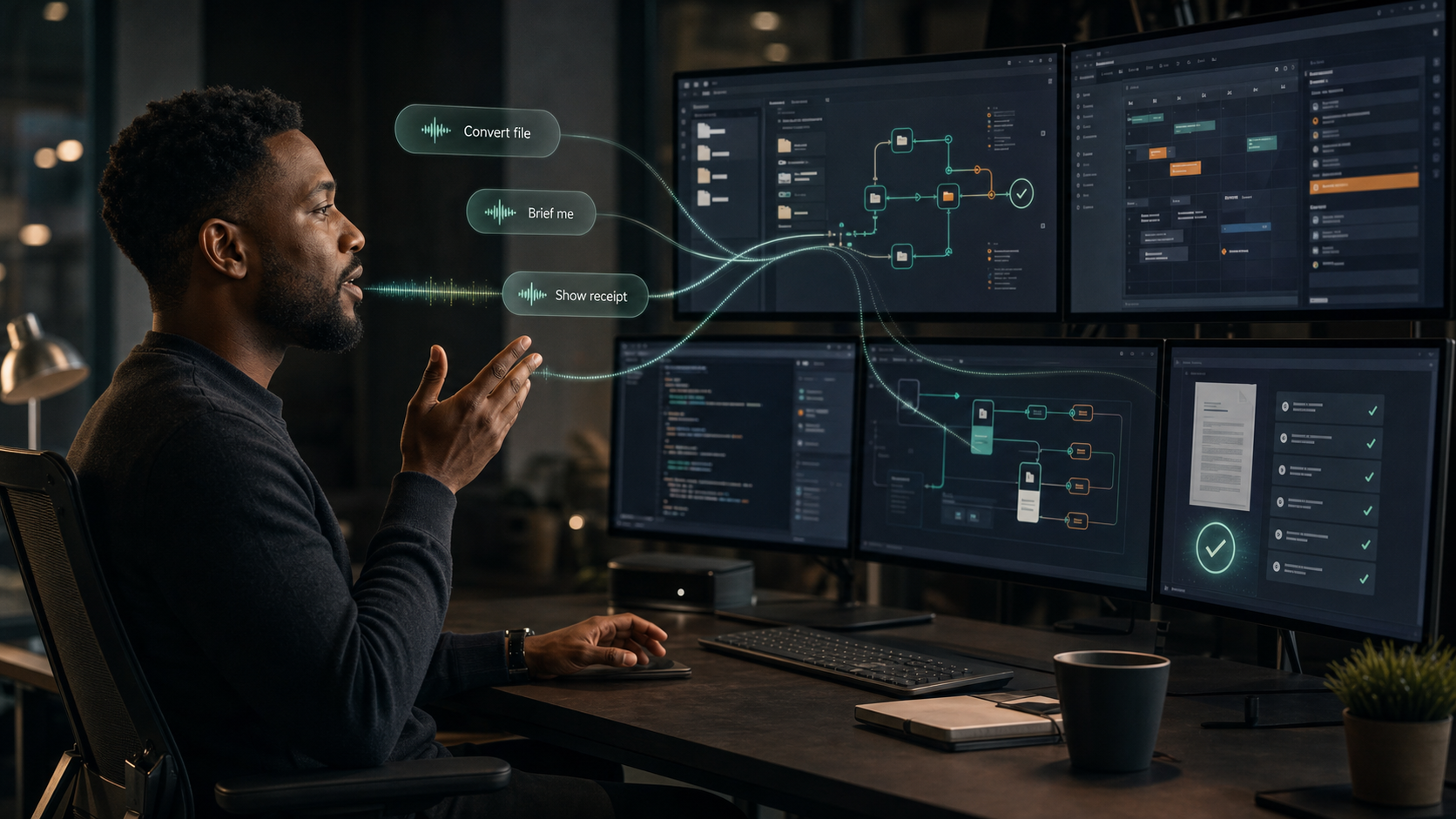
I just say what I want done.
Pull the context. Draft the reply. Check the calendar. Read the transcript. Find the source. Update the note. Leave the email for review. Run the test. Bring back receipts.
That used to be a list of clicks.
Now it is closer to giving instructions to an operator.
That shift sounds small until you watch it happen inside real work. The old software motion was simple: a human logged into a tool, navigated the interface, clicked the right buttons, copied the right data, pasted it into the next place, and tried not to miss anything important along the way.
Most of us got so used to that motion that we stopped seeing it.
We called it work.
A lot of it was really interface labor.
Open the CRM. Search the contact. Open the email thread. Find the last promise. Check the meeting notes. Open the calendar. Confirm the date. Draft the response. Copy the link. Save the note. Create the task. Send the follow-up.
None of those steps are useless. They exist because the work has to move.
But the human is carrying too much of the movement.
This is where natural language starts to matter.
I am not talking about typing a cute prompt into a chatbot and getting a clever paragraph back. That was the first version most people saw. Useful, but limited.
The bigger version is when natural language becomes the command layer across the stack.
You state the outcome.
The agent figures out which tools matter, gathers the context, prepares the work, stops at the right gate, and shows proof.
That is a very different relationship with software.
The interface does not disappear. I do not think that is the right frame.
The interface changes jobs.
Instead of being the place where every human has to manually operate every step, the interface becomes the place where you review, approve, inspect, correct, and trust.
That matters because the next wave of software will not be judged only by how clean the dashboard looks.
A clean dashboard still matters. People need to see things. Teams need visibility. Operators need control.
But I am starting to ask a different question:
Can I tell the system what I want in plain English and get back a useful, verified work product?
That is the new interface test.
If I ask, "What do I need to do before this client call?" the answer should not be a pile of tabs.
It should be a briefing with the latest emails, notes, calendar context, source links, open decisions, and what is uncertain.
If I ask, "Draft the reply, but do not send it," the system should know the difference between preparation and external action.
If I ask, "Analyze this repo, make the fix, run the tests, and bring back receipts," the system should not hand me a motivational paragraph about debugging.
It should do the work, or tell me exactly where it got blocked.
That last part is important.
Natural language without verification is just a smoother way to be wrong.
The magic is not that the agent answers you in English. The magic is when English becomes the way you control a workflow that still has sources, tools, permissions, logs, and human review points.
I would have missed this a year ago.
I would have treated natural language like a better search bar.
Now I think it is closer to the new operating layer.
Playbook
Here is the practical version.
Natural language only becomes useful when the system underneath it can actually move.
That is the part people miss.
You cannot direct in terms of outcomes if the system has no way to act on the outcome.
If the agent cannot read the context, touch the right tools, stop at the right gates, and bring back proof, plain English is only a nicer command line into a broken process.
So the playbook is more specific than "talk to AI more."
Build the conditions that let natural language control real work.
1. Start with the outcome sentence
Pick one workflow where you currently open three or more tools to produce one answer or one output.
Then write the sentence you wish you could say.
For example:
"Prepare me for the Darius meeting at 4 PM."
"Find the latest version of the client package and tell me what still needs review."
"Turn this saved video into a content reference with the hook, edit pattern, category, and why I saved it."
"Check whether the follow-up email was actually sent and show me the receipt."
That sentence is the interface because it names the outcome.
Now map what the system has to do underneath it.
2. Connect it back to the agentic stack
This is why the last few posts matter together.
The Agentic Tool Test asks whether the tool has a door for agents.
What Is an Agent, Actually? separates chat from a system that can work.
The New Software Stack maps the route across tools, context, approval, and receipts.
Natural language sits on top of that.
If the route does not exist, the sentence cannot go anywhere.
It can sound impressive. It can return a polished answer. But it cannot reliably run the work.
So before you call natural language your interface, ask the boring question:
Can the system actually complete the workflow?
3. Define what the command means
Plain English can feel obvious to the human and vague to the machine.
"Prepare me for the call" could mean calendar, emails, notes, Fathom transcripts, open tasks, CRM status, prior proposals, and the last thing the person asked for.
The agent needs that definition.
Good natural-language systems are built on clear operating meanings. When I say "brief me," the stack should know what sources to check, what format to return, and what counts as done.
That definition is a new kind of operating document.
It is almost like teaching a new employee what a phrase means inside your company.
Except the employee can read every folder, call tools, run scripts, draft outputs, and come back with receipts if you set the system up correctly.
4. Add voice where it actually helps
Typing prompts is the beginner version of natural language.
Voice is where this gets more interesting.
We are already watching systems move toward voice as the first control layer. That can be dictation. It can also be actual computer control.
Whisper is the obvious example on the speech-to-text side. It turns spoken language into text so the system can use it.
Vowen is closer to the daily operator version I like because it pushes beyond dictation into voice workflows and command mode. Say the thing. Let the computer do the thing.
That is a bigger shift than it sounds.
If I can say, "Convert this Markdown file to a PDF," I should not have to open a browser, search for a Markdown-to-PDF converter, upload the file, click through the UI, download the result, and move it back to the right folder.
The natural-language version is:
"Convert this file to a PDF and put it next to the original."
The agentic version is:
The system understands the file, chooses the tool, runs the conversion, saves the output, and tells me where it landed.
That is where voice stops being a faster keyboard.
It becomes a control surface.
5. Decide where the agent stops
This is where a lot of people get nervous, and honestly, they should.
Design the stop signs.
Draft the email, but do not send it.
Recommend the pricing change, but do not apply it.
Prepare the client summary, but let the human review it.
Flag the risk, but do not delete the file.
The human does not need to click every step. The human needs to own the judgment points.
Cleaner job.
Better use of brainpower.
This connects back to the orchestration job from You Are the Bottleneck and the verification discipline from Trust But Verify.
The human role is moving toward orchestration and validation.
Natural language is the way you orchestrate.
Receipts are how you validate.
6. Make the receipt part of the command
Every natural-language workflow needs proof.
If the agent says it sent something, show the Sent Items record.
If it says it changed code, show the files, tests, and commit.
If it says a meeting is at 4 PM ET, show the calendar source.
If it says there were no new X bookmarks, it better have actually checked the live bookmark source. Ask me how I know.
That is the difference between an assistant and a liability.
Receipts turn natural language from "trust me" into "here is what happened."
7. Practice speaking in outcomes
This is the new skill.
A lot of people think the skill is prompt engineering.
I think the more durable skill is outcome communication.
Can you clearly say what you want done?
Can you define what good looks like?
Can you explain what sources matter?
Can you name where judgment belongs?
Can you tell the system what proof to bring back?
That is communication. The audience has changed.
You are communicating with an operating system that can act.
The better you get at that, the better your agents get.
In an agentic world, your ability to communicate is directly tied to your ability to orchestrate.
That is uncomfortable for some people because it means vague leaders will build vague systems.
Clear operators are going to have an advantage.
8. Pick the return format
Sometimes the answer should be a dashboard.
Sometimes it should be a draft.
Sometimes it should be a table.
Sometimes it should be one sentence that says, "Do this next."
The old interface made the human go into the software and pull the answer out.
The new interface should bring the answer back in the shape the work needs.
That is the part I keep watching in my own stack.
The value is bigger than faster typing.
The value is less manual carrying.
Orientation
Natural language is becoming the front door to work.
But the front door only matters if there is a real house behind it.
A chatbot sitting on top of a messy business process will eventually expose the mess. It might make the mess easier to talk to. The mess stays.
The companies that get this right will design the workflow underneath the command.
They will know what each instruction means.
They will know which tools the agent can use.
They will know where the human approves.
They will know what proof comes back.
That is the difference I am watching.
Old software asked humans to learn the interface.
New software needs to understand the instruction.
The human role moves up a layer: intent, communication, context, approval, judgment, correction.
Better job than professional tab switcher.
But it requires a new skill set.
You have to learn how to speak in outcomes.
You have to learn how to design stop signs.
You have to learn how to ask for proof.
You have to learn how to communicate with a system that can actually act.
That is why I think natural language is where this is going.
Not because typing gets replaced.
Because the people who can communicate clearly with agentic systems are going to build better systems.
Next is The Blockbuster Test, because this interface shift is where a lot of companies are going to reveal what they really are.
Some will adapt.
Some will keep polishing dashboards while the work moves around them.
Comment below and tell me: what is one workflow you wish you could run by just saying what you want done?
I read every one.
- Brian