
Field Notes
You can get AI psychosis very, very quickly.
I do not mean that as a joke. I mean the feeling that hits when you first see real force multiplication up close.
At first, it feels like relief.
A few weeks ago, I was at dinner with a close friend in Atlanta. Two operators talking shop. I pulled out my phone and showed him what Atlas had built that day.
His own people file. A client call from that morning turned into a clean summary with quotes and follow-up threads. A proposal draft with options, open questions, and pricing logic. Notes filed where I could find them again.
He looked at it and said, "Bro. I want the whole setup."
That is the first wave.
You see what the agent can do and you want the system.
Then the second wave hits.
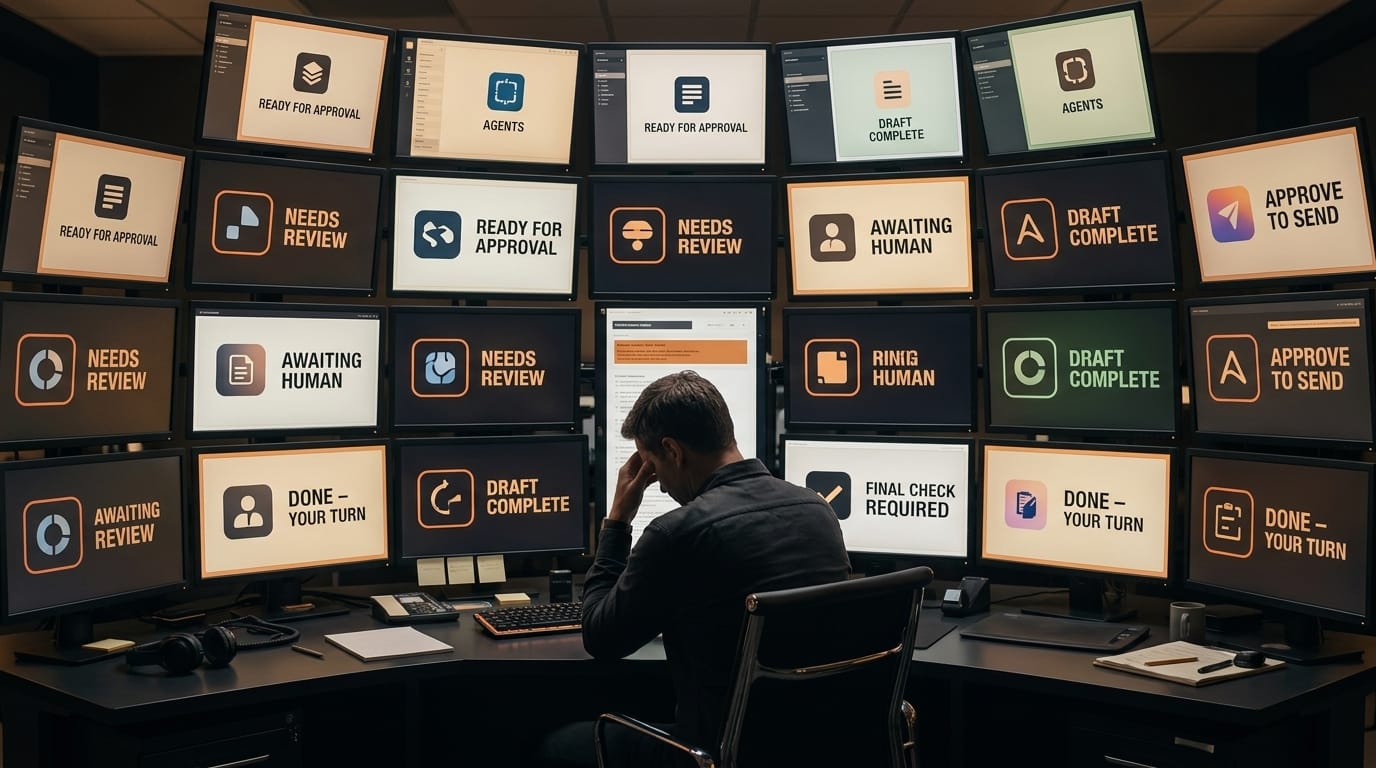
You realize the machine can move faster than you can direct it.
That is the uncomfortable part of this whole AI shift. Execution got cheaper. Judgment got more expensive.
The bottleneck moves.
For years, a lot of value lived in doing the task. Writing the email. Pulling the report. Summarizing the call. Searching the file. Building the deck. Clicking through the software.
Now more of that can move downstream to agents.
The work does not disappear. It changes shape.
Someone still has to decide what should happen. Someone still has to give the system enough context. Someone still has to review the output and know whether it is right, safe, useful, and worth sending.
That person is the bottleneck.
And in a lot of businesses, that person is the operator.
I have said some version of this in rooms with accountants, students, business owners, and my own team: moving forward, if I see you doing a repeatable task that an agent could have done, we have a problem.
Not because the task is beneath you.
Because your judgment is too valuable to bury inside work the system can learn to run.
That sounds clean when I write it.
It is much messier to live.
I am in that mess right now. I am watching parts of my calendar empty out and realizing the next job is more exposed. There is less hiding behind busywork. Less comfort in being the person who just gets things done.
The old work gave me a feeling of motion.
The new work asks for clarity.
What should the agent do? What context does it need? What rules should it follow? Where should it stop and ask me? What does good look like? What proof do I need before I trust it?
That is the new operating layer.
AI does not remove judgment. It exposes where judgment was never written down.
Playbook
The practical version starts with one question:
What are you still holding in your head that prevents the system from moving without you?
Do not start with your job title.
Start with yesterday.
Pick one repeatable thing you did yesterday that an agent could have helped with.
Maybe it was a client follow-up. Maybe it was inbox triage. Maybe it was pulling context before a meeting. Maybe it was summarizing a call. Maybe it was turning messy notes into a cleaner plan.
Write it down like you are handing it to a smart intern on day one.
Not a perfect prompt. Not a fancy automation. Just a clear explanation.
What starts the task?
What does the person need to know?
What tools are allowed?
What rules matter?
What should come back?
What needs your approval before it goes anywhere?
That last question matters.
I think of AI agents like brilliant interns with espresso. Fast, capable, occasionally too confident. You do not fire the intern because they ask a question. You build the question into the system.
That is the "I do not know" gate.
The agent should be allowed to stop. It should be allowed to say, "I do not have enough context." It should be allowed to ask for judgment instead of guessing.
That is useful.
That is infrastructure.
Every time the agent stops, you learn where the workflow is unclear.
Then you fix the workflow.
Over time, the system needs you less for execution and more for the places where judgment actually matters.
That is the Harvey and Mike Ross version, if you have watched Suits.
Mike has the memory. Harvey has the judgment.
The AI can be Mike. Fast, smart, loaded with information.
You still need Harvey.
Someone has to know what matters, what does not, what the client can actually hear, where the risk is, and when the smart answer is still the wrong move.
That is the job.
Orchestration and validation.
Send the right work down. Review what comes back. Improve the system when it breaks.
Orientation
This is where the last post lands.
If workflows are the new primitive, then the operator's job is to define the workflow clearly enough that the system can run it.
That is why this transition feels weird.
This is bigger than a tool change. It is an identity change.
A lot of us built our confidence around being the person who could execute. The person who could figure it out. The person who could jump in, clean up the mess, write the thing, send the follow-up, remember the context, and keep the machine moving.
That version of work got us here.
It will not get us all the way through what is coming.
I am in my refactor period right now. I have to let go of a lot of things to make room for new things.
That sounds like a poster line. Unfortunately, it is also true.
The next edge is not learning one more AI tool.
The next edge is turning judgment into systems without losing the taste that made the judgment useful in the first place.
Next time, we are getting into The Refactor Period. What happens when the dust settles, the old work leaves your hands, and you have to rebuild your systems, habits, and identity around the new standard.
Comment below and tell me: what is one task you did this week that an agent could have done instead?
I read every one.
— Brian