
Field Notes
The last post on The Agentic Tool Test asked a simple question: can this tool be used by an agent?
Can the agent get in? Can it read the current state? Can it take action? Can it stop before the human-review point? Can it leave proof?
Good first question. But it is only the first question.
Because you can pick the right tool and still have a broken stack.
You still have to know what workflow the tool belongs inside.
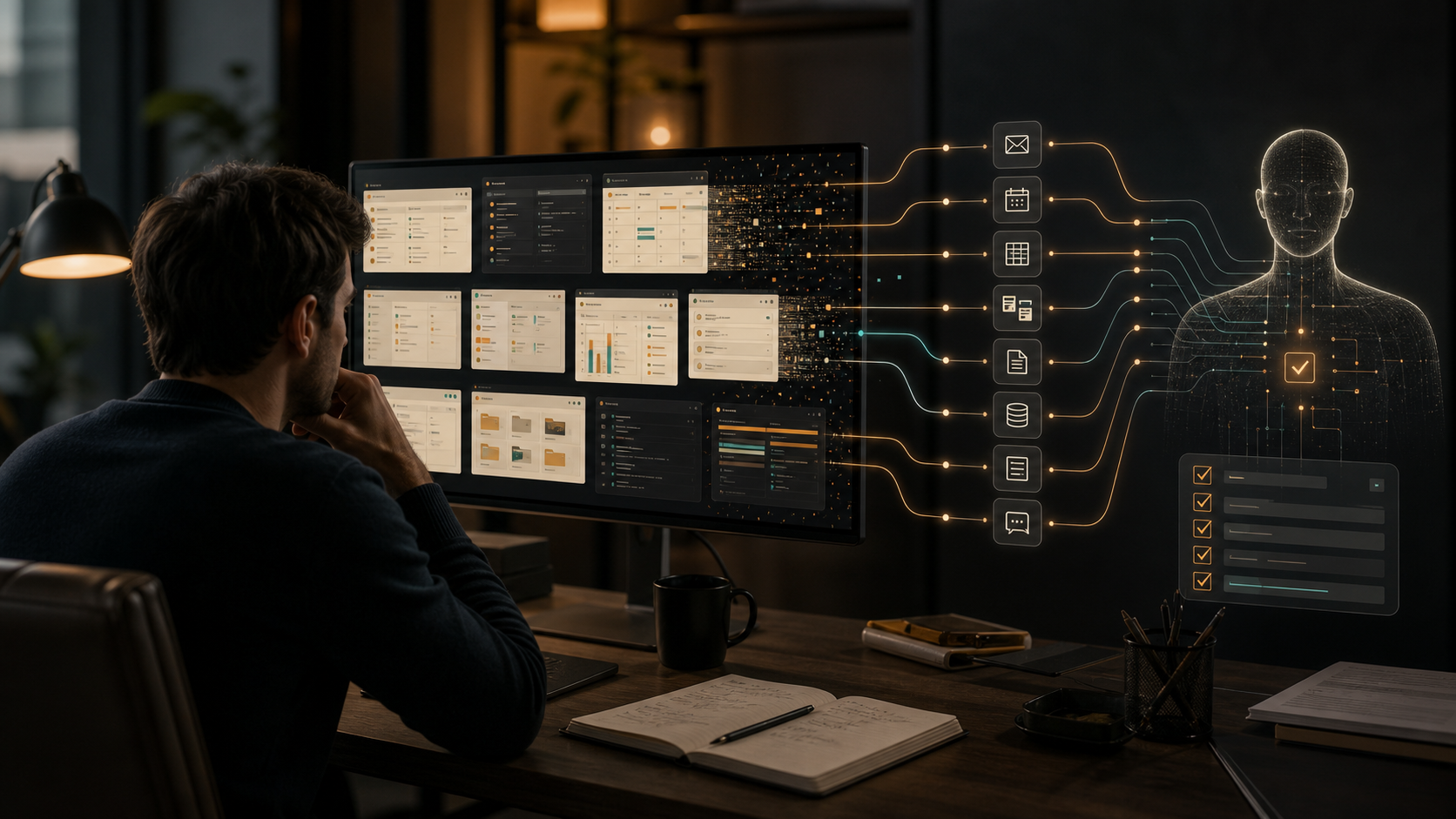
Most businesses do not run on one tool. They run on a messy chain of forms, email threads, call recordings, CRMs, docs, payments, dashboards, meetings, memory, and follow-up lists.
That chain is the real stack.
The software logos are only the visible part.
The workflow underneath is what matters.
AI agents do not replace that workflow. They expose it.
If the workflow is vague, the agent will show you where it is vague. If nobody knows where the data lives, what happens next, who approves the output, or what good looks like, the agent will hit the same wall your team hits. It will just hit it faster and with more confidence, which is always a fun little horror movie.
The Model Doesn't Matter. The Workflow Does. is the piece I keep coming back to.
The model is the engine. The workflow is the machine.
When the workflow is clear, documented, and connected to the right systems, an agent becomes much easier to plug in. It can follow the path. It can gather the data. It can prepare the output. It can stop at the review point. It can leave proof.
The new software stack is the route work can take through those tools.
Dashboards make this obvious.
Most people open dashboards because a human needs an answer.
How much revenue did we book? Which leads need follow-up? What changed in the pipeline? What does the owner need to know?
Dashboards exist because humans need to log in, filter, compare, and pull answers out.
In an agent stack, that starts to change.
If the agent can move through the tools, you do not always need to open the dashboard. You can ask for the answer as a summary, table, memo, draft email, decision brief, or scheduled Friday report.
That changes how I buy software. A clean interface still matters. The bigger test is whether the system can answer the question without making a human carry the data across the room.
The tool test asks whether one tool has a door for agents.
The tool landscape helps you decide which kind of agentic tool belongs in which part of the job.
The stack test asks whether the whole workflow has a route.
That blend is the point.
A pile of dashboards and systems is not enough.
The new software stack is a collection of agentic tools, routed through the right platforms, that can complete business processes end to end while stopping where human judgment belongs.
Playbook
Here is the practical version.
Do not start by listing every app in the company.
Start with one business question.
Pick a question someone opens software to answer every week.
Which leads need follow-up? Which owner needs an update? Which payment happened, and what should happen next?
Now map the answer.
Keep three prior questions in the room while you do it.
From The Model Doesn't Matter. The Workflow Does.: what is the workflow?
From The AI Tool Landscape: which category of tool is right for each step?
From The Agentic Tool Test: can that tool actually be used by an agent with access, action, stop signs, and proof?
1. What is the question?
Write the question in plain English.
Not the report name. Not the dashboard title. The actual question the human is trying to answer.
"What changed in the pipeline since yesterday?" "What do I need to send this client now that they paid?" "What did we promise on the call?"
This matters because agents work better when the job is clear.
If the question is fuzzy, the workflow will be fuzzy.
2. Which systems hold the answer?
Most answers are scattered across the CRM, email, transcripts, Stripe, spreadsheets, PMS data, project boards, and notes.
You are no longer asking, "Do we like this tool?"
You are asking, "What role does this tool play in answering the question?"
Better buying lens.
Some tools are systems of record. Some are action surfaces, inboxes, memory layers, approval points, or reporting layers.
When you know the role, you can design the route.
3. Which source of truth wins?
A lot of stacks quietly break here. The CRM says one thing. The spreadsheet says another. The email thread has the latest detail. The human remembers a different version.
An agent cannot fix that by being smarter.
Someone has to decide which system wins.
For each important fact, pick the source of truth: customer email, payment status, property data, meeting recap, next step, approval status.
If the answer is "ask Brian," that may be fine for a while. Just be honest that Brian is still part of the stack.
4. What can the agent do after it has the answer?
Here the stack turns from reporting into operations.
Can the agent draft the follow-up, update the CRM, create the task, generate the report, prepare the proposal, schedule the reminder, or send the resource only after payment is verified?
Reading is useful. Action is where the value shows up.
A chat tool might reason through the answer. A coding agent might update the internal app or script. A workflow automation tool might handle the repeatable handoff. A personal agent might read the inbox, transcript, calendar, notes, and source systems together.
Agent-ready software matters here. A tool with an API, MCP server, command-line tool, webhook, reliable export, or stable browser surface gives the agent a clean way to act.
A tool that only works when a human clicks around can still be part of the stack. It just needs a different treatment: wrap it, replace it, or keep it for now and stop pretending it is agent-ready.
Before you trust any tool in the chain, run it through the Agentic Tool Test.
Can the agent access it, use it, stop safely, and show what happened?
If the answer is no, it may still be useful. It just cannot be the backbone of an end-to-end agentic workflow yet.
5. Where does the human make the call?
The human does not disappear. The human moves to the judgment point.
Draft the email, recommend the pricing change, or prepare the client memo. Then stop.
Assemble the answer. Let the operator decide.
Cleaner division of labor.
The agent moves the process.
The human makes the call.
6. How should the answer come back?
Here is the dashboard replacement question.
Sometimes the answer should still be a dashboard. Sometimes it should be a memo, alert, draft email, note, or nothing until a threshold gets crossed.
The old stack made humans go looking for answers.
The new stack should bring the answer back in the format the work requires.
And it should bring receipts.
Sent Items verification. Stripe checkout session ID. Calendar event ID. Git commit hash. Test output. Draft ID. Source path. Screenshot. Log line. CRM update.
Proof beats model confidence every time.
Orientation
The new software stack is a workflow map before it is a logo map.
The first question is whether the tool is right.
The next question is which agentic tool or platform should handle each step.
Then comes the real test: whether the work can move through the stack.
Most businesses will feel the pain on that second question.
They will buy an AI tool, connect it to one system, and then wonder why the agent still cannot do the job.
Usually the reason is simple: the process was never really mapped, the data lived in too many places, or the approval rule was unwritten.
The dashboard answered a human question, but the stack was never designed to answer it directly.
I keep watching that shift.
Software used to be something humans opened.
Now software needs to become something agents can move through.
One agentic tool is not the stack.
A workflow mapped across the right tools, with the right agent doing the right job, is the stack.
That does not make the human less important. It makes the human's role clearer: operator, reviewer, judge.
Better job than professional tab switcher.
Next is [Natural Language Is the New Interface].
Once the stack can answer questions, the way you operate it changes too.
You stop spending all day clicking through software like a user.
You start directing work like an operator.
For now, comment below with one question you open software to answer every week.
I want to see the questions hiding inside the dashboards.
I read every one.
— Brian