
Field Notes
A company can look healthy and still be built for the wrong world.
That is the uncomfortable part I keep coming back to.
I was in a leadership conversation recently where the obvious question was which AI tools the company should use. Claude, ChatGPT, Gemini, internal models, all the normal suspects.
But that was not the question sitting underneath the room.
The real question was whether the business could keep operating the same way after AI becomes the default mode of work.
That is a much harder conversation.
Because tools are easy to buy. Workflows are harder to admit are outdated. People are even harder.
Then Stripe gave the whole thing a public receipt.
They posted a role called Forward Deployed AI Accelerator, Marketing. That title did not exist in most companies 12 months ago. The job is to sit with cohorts of roughly 20 marketers, learn their work, build custom tools, agents, automations, and skills, then coach the team until the workflow changes permanently.
Read that again.
The job is not “teach people ChatGPT.”
The job is to live inside the work until the work is different.
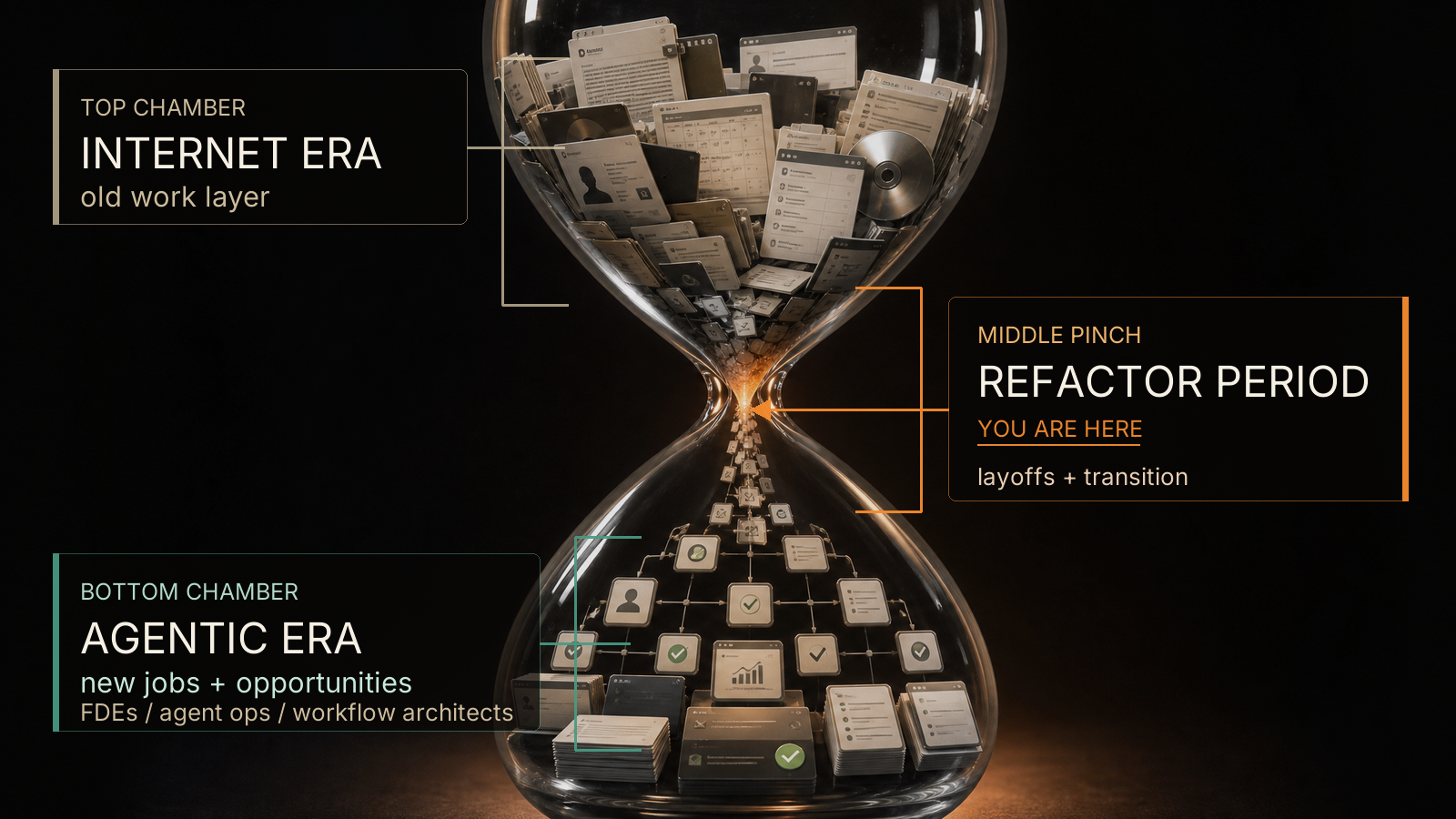
That is the refactor period.
I have used the Blockbuster and Netflix example a lot because it still holds. I wrote about that old-world/new-world shift in Welcome to the New World. Blockbuster did not lose because streaming was a neat feature. They lost because the operating system underneath the business changed.
The old company was built around stores, shelves, late fees, inventory, employees at counters, and customers driving somewhere to rent a movie.
Netflix moved the layer underneath the work.
Same human desire: watch something good tonight.
Different machine under the desire.
That is what AI is doing to a lot of businesses right now.
The dangerous version is pretending this is a normal software upgrade. Add the tool. Train the team. Write a policy. Put “AI-first” in a deck. Keep moving.
I do not think that is enough.
The line I keep repeating is simple: the way the business functions today is impossible if the future standard of work is different.
That sounds dramatic until you look at the Stripe role again.
They are not waiting for every employee to magically upskill themselves. They are embedding someone into the workflow. The success metric is not enthusiasm. It is permanently transformed work.
That is the part most businesses will miss.
They will buy the tool and skip the refactor.
I get the temptation. I am in my own refactor period right now. I am looking at old ways I made money, old workflows I personally carried, old habits that made me feel productive, and realizing some of them only made sense in the old world.
That is annoying.
It is also freeing.
Once you see the work as something that can be redesigned, the whole map changes.
Playbook
The practical version starts small.
Do not announce a company-wide AI transformation.
Pick one workflow from the last 7 days.
Something real. A client follow-up. A weekly report. A sales handoff. A property pricing review. An invoice check. A proposal draft. A marketing review. Anything that repeats enough to have a pattern.
Then write the workflow down like you are handing it to a sharp person on day one.
What starts it?
What information is needed?
What decisions get made?
What tools are used?
Where does judgment matter?
Where does approval matter?
What output proves the work is done?
Most people skip this part because it feels too basic.
That is the trap.
If you cannot write the workflow clearly, you cannot safely hand it to an agent.
Once the current path is visible, mark each step with one of six labels:
- retrieval
- judgment
- drafting
- routing
- execution
- verification
Now you can see where AI belongs.
Retrieval is usually easy. Drafting is usually easy. Routing can often be automated. Verification needs rules. Execution needs guardrails. Judgment needs a human until the system has earned more trust.
This is where the agentic loop becomes useful.
The human gives the goal. The system pulls context. The agent proposes or acts. The result gets measured. The human validates. The correction becomes better context for the next loop.
That last part matters.
A lot of people treat AI mistakes like proof the system is useless. I treat them like workflow tickets.
If the agent guessed, where should it have stopped?
If it missed context, where should that context live?
If the output was technically right but practically wrong, what judgment was still trapped in your head?
That is the work.
Run that loop for one workflow for 6 weeks.
Not 30 workflows. One.
Make the workflow clearer. Add the context. Add the approval gate. Add the dry run. Add the measurement. Watch where the human still has to step in.
That is how refactors actually start.
Small enough to touch.
Important enough to matter.
Orientation
This is where the last two posts connect.
If workflows are the new primitive, then the workflow is the thing to redesign.
If you are the bottleneck, then your job is to turn hidden judgment into a system the agent can use without making the business reckless.
The refactor period is what happens when those two ideas become real.
It looks plain at first.
It looks like documenting steps you used to carry in your head. It looks like admitting the system only works because one person remembers the exceptions. It looks like finding the parts of the job that still exist only because nobody stopped long enough to rebuild them.
I think the next serious companies will have some version of Stripe’s role.
Maybe they call it an AI accelerator. Maybe workflow architect. Maybe embedded builder. Maybe something we have not named yet.
The title matters less than the function.
Someone has to sit inside the work until the work changes.
That is the refactor.
Next, I want to go deeper on why AI lies to you, and why the fix is usually architecture before it is prompting. If the agent has no path to say “I do not know,” it will guess. That is not magic. That is a system design problem.
I am turning this refactor audit into a working guide for Pro members: the hourglass visual, the agentic loop diagram, and the workflow worksheet I would use to run the first 6-week sprint.
The public post gives you the map.
The guide will give you the tool.
Comment below and tell me one workflow in your business that feels too important to touch.
That is probably where the refactor starts.
I read every one.
— Brian