
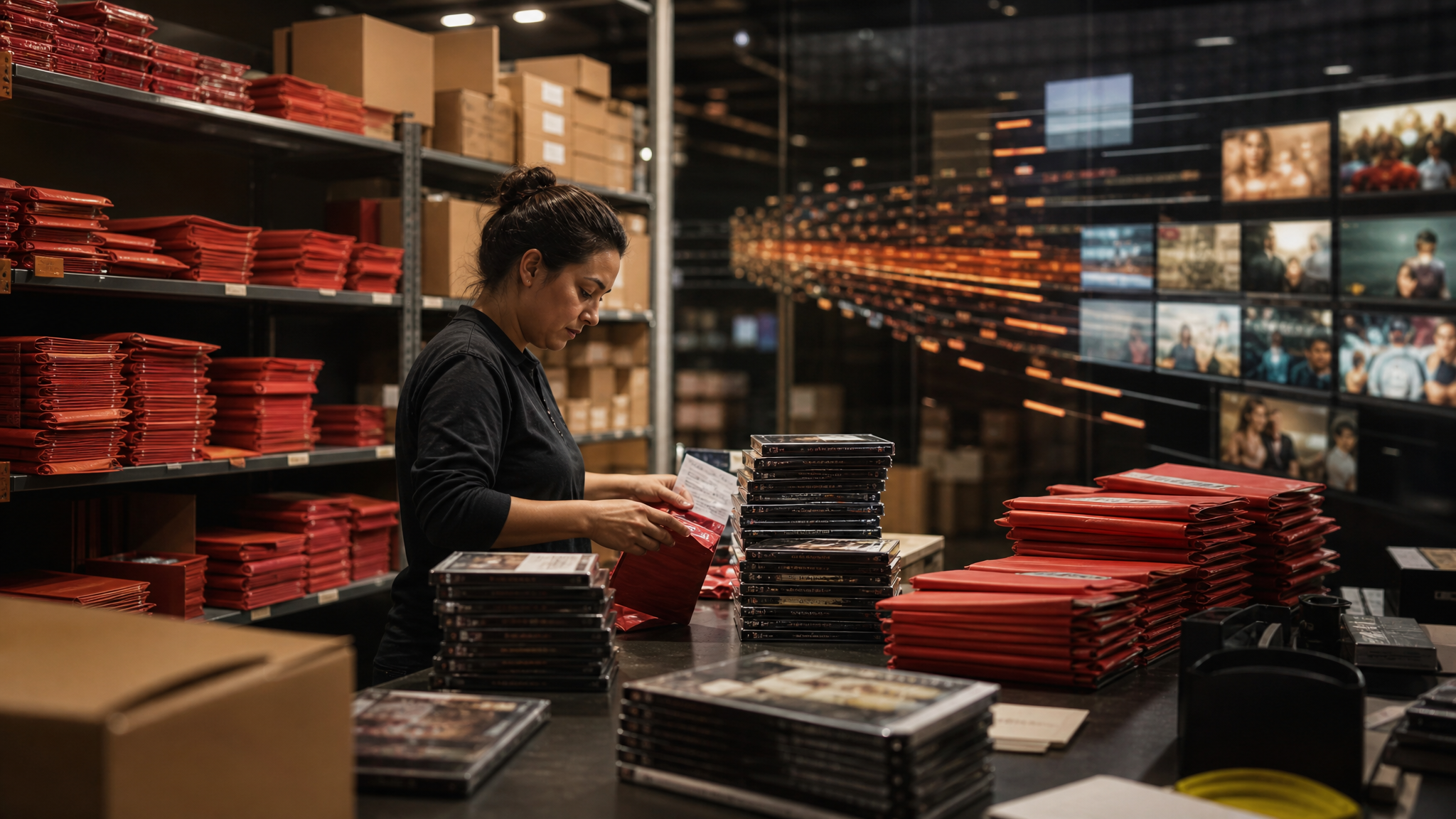
Someone at Netflix used to burn CDs for a living.
Not a metaphor.
In the early days, that was a real job: pulling DVDs off a shelf, sliding them into mailers, shipping them out, and helping run the machine that got movies from a warehouse to your living room.
Then streaming happened.
That role did not just go away. The entire layer of work it sat on disappeared.
What replaced it was not a slightly faster version of the same job. It was a completely different world: engineers designing recommendation systems, product teams shaping streaming experiences, data teams learning what people watched before they even knew what they wanted next.
Same company. Same customer desire. Completely different operating system underneath it.
That is the part I keep coming back to with AI.
Most people are still asking which tasks AI will replace. I think that question is too small.
The bigger question is: what layer of work is disappearing underneath us?
Because that shift is already happening.
Not eventually. Not “in a few years.” Now.
Across every industry, every role, every company, the old assumptions are starting to break. The org charts, the hiring plans, the way teams think about productivity, the software people use, the workflows people defend because “that’s how we’ve always done it” — most of it was designed before AI could do what it does today.
And if the layer underneath the work changes, the playbook has to change with it.
That is what The New World is about.
I'm not going to pretend I have it all figured out. I'm an operator and business owner running through this same transition in real time.
Building with AI every day, watching what works, getting things wrong, adjusting. Some days it feels like magic. Some days it feels like babysitting a room full of brilliant interns who all found espresso at the same time.
Both are true.
I have watched AI make me faster. I have watched it expose gaps in my own systems. I have watched it turn a vague voice note into a usable plan, and I have watched it confidently produce something that needed to be audited line by line before it could be trusted.
That is the race we are in.
Not a race to use every new tool. Not a race to sound smart at dinner when someone says “agentic.” A race to understand what is actually changing, what still matters, and what to do next.
The New World is my attempt to break down what I'm seeing in a way that's actually useful.
Three times a week, you’ll get:
Field Notes — what actually shipped, moved, broke, or became obvious this week.
Playbook — one tool, one workflow, one repeatable win you can steal and use.
Orientation — the bigger map: who is building what, why it matters, and how the ground is shifting under operators, teams, businesses, and everyday people like you and me.
The goal is simple:
Help people who feel behind bridge the gap, so they know exactly what to do.
No hype cycle recaps. No sponsor paragraphs disguised as insight. No “5 AI tools to 10x your productivity.”
Just letters from inside the work.
If something worked, I’ll show you. If something broke, I’ll show you that too. If I’m wrong about something, I’ll update in public.
Because that is the only honest way I know to write about this moment.
The new world is not coming.
It is already here.
The question is whether we can learn to see it clearly enough to move.
Hit reply and tell me what you are trying to understand right now.
I read every one.
— Brian