
Field Notes
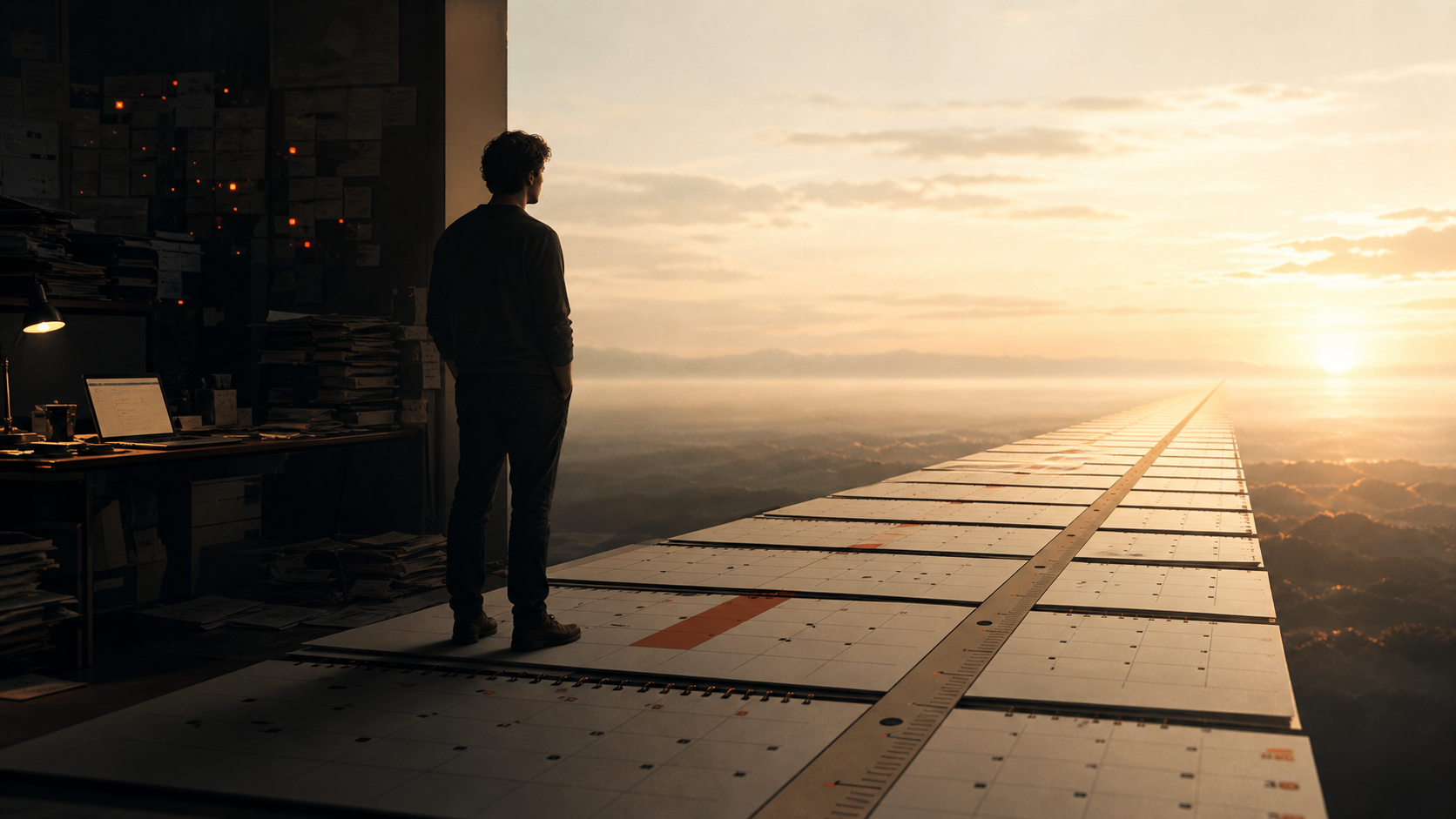
The real test is a calendar question.
If you stopped working today, how long could you stop before you had to put yourself back into the rat race?
I keep coming back to that.
People think they are chasing more money.
I think most of us are chasing more freedom.
Money matters. It pays the bills, funds the team, covers the downside, and gives you more shots on goal.
But money is not the whole scoreboard.
If the money comes with a calendar you do not control and a business that only moves when you personally drag it forward, you may have built a higher-income cage.
AI is forcing me to look at that harder.
Boris Cherny, the creator of Claude Code, has a frame I keep thinking about from a Sequoia interview: using AI to build and create is having a printing-press moment.
The point goes the other way: people no longer need to become traditional coders to build useful things.
Coding does not mean what it used to mean.
Before the printing press, books were expensive, knowledge moved slowly, and far fewer people could participate in the world of ideas.
Now a person can open an AI tool, say what they want in normal language, and start creating the thing. People call this vibe coding. The technical requirements are collapsing toward zero.
When building software starts to feel closer to sending a text message, the world changes. More people can build tools, apps, workflows, automations, dashboards, and little internal systems.
That does not automatically make everyone free.
But it changes who gets to build the systems that create freedom.
Last time, we talked about emotion as the moat. Once everyone can move faster, the way people feel becomes a bigger differentiator.
After that, there is a more personal question.
What are we buying with all this speed?
More output is fine. More options is better.
I like this measuring stick because it cuts through the noise.
Can you take a Tuesday back, go on the trip, and let the work continue without secretly running the company from your phone?
If the answer is no, AI may have made you faster, but it has not made you freer.
Faster can feel like progress right up until you realize you are running the same treadmill at a higher speed.
Playbook
I read a piece from Dan Shipper at Every recently called After Automation, and the point that stuck with me was simple: automating work does not make human work disappear. It changes the human job.
Default output gets cheaper.
Judgment gets more valuable.
Taste gets more valuable.
Verification gets more valuable.
The person who was valuable because they were the only one who could make the thing is in a tougher spot. The person who can decide what should be made, verify whether it is any good, and connect it to a real business outcome becomes more valuable.
That connects directly to freedom.
If AI only helps you make more stuff, you can accidentally create more work for yourself. More drafts to review. More leads to respond to. More automations to babysit.
Ask me how I know.
The better question is whether the system removes a recurring dependency on you.
I am thinking about this in my own business right now.
I am building content, training, consulting, and internal agent systems because I do not want the whole thing to depend on Brian personally doing every call, follow-up, analysis, draft, and next step.
That would be a smarter cage.
The better version is a company that can teach more people how to do the work, train partners into the standard, let agents prepare context, and keep human judgment where it matters.
AI should help you do more than finish the task faster.
It should help you remove the task from the wrong person.
Sometimes that means an agent drafts the email.
Sometimes it means the agent watches the inbox and only alerts the human when there is a real decision.
Sometimes it means a workflow that lived inside your head becomes a written process someone else can run.
Here is the audit I would run:
- If I stopped working today, how long before I had to re-enter the race?
- Which workflows would pull me back first?
- Which decisions actually require my judgment?
- Which decisions only require my memory?
- Which tasks only exist because the system is poorly documented?
- What would I do with the time if I actually got it back?
That last question matters.
Because if you do not know what the time is for, you will fill it with more work by default.
I have done that.
You free one hour and somehow create three more obligations. You automate the annoying thing and use the extra space to chase another moving target.
That's the trap.
Speed is a tool.
Freedom is a design choice.
Orientation
This connects the first arc of The New World.
The Refactor Period was about the old layer of work breaking apart.
You Are the Bottleneck was about the uncomfortable realization that the system often stops at you.
Specified Intelligence was about putting the right brain on the right job.
Emotion Is the Moat was about using that system to create a better experience.
The reason underneath all of it is freedom.
Not fake freedom where you can technically work from anywhere while your business follows you around like a smoke alarm with low batteries.
Real freedom.
The ability to choose where your attention goes.
The ability to step away without the machine falling apart.
The ability to build something that compounds without using your nervous system as the operating system.
I think the best operators are going to use AI for that.
The printing press made knowledge cheaper to spread. Wisdom was still up to the reader.
AI makes systems cheaper to build. Freedom is still up to the operator.
Freedom still depends on what you build with it.
Some people will use it to flood the internet with more output.
Some people will use it to look advanced while staying trapped in the same old workflows.
But the people I am paying attention to are asking a better question:
What part of my life does this actually give back to me?
The new world is bigger than what AI can do.
It is about what you no longer have to carry alone.
Comment below and tell me one workflow that keeps pulling you back into the rat race.
I read every one.
— Brian