
Field Notes
The clearest AI signal right now is the org chart starting to move.
Block (formerly Square) published a piece called From Hierarchy to Intelligence. Their point was simple. Companies used hierarchy to move information around.
Context moved up.
Decisions moved down.
Managers kept the machine stitched together.
AI changes that math.
Block is now talking about individual contributors who build and operate capability layers, directly responsible individuals who own customer outcomes, and player-coaches who still build while developing people.
Ramp is showing the same shift from the AI-native company side. In a recent interview with Geoff Charles, Ramp's CPO, they talked about non-engineers shipping production code, the product manager role splitting in new directions, and an internal L0-L3 framework for getting every employee to build with AI.
Stripe hiring Forward Deployed AI Accelerators is another receipt. I just do not think Stripe is the main story here.
Then ClickUp CEO Zeb Evans posted the uncomfortable version out loud. ClickUp reduced headcount by 22% while describing a move toward a "100x organization." He talked about 10x engineers directing AI agents, PM and design merging, system managers owning AI systems, and front-liners spending more time with customers while software handles more of the rest.
I do not like talking about layoffs like they are a clean strategy slide.
Real people are affected.
But ignoring the signal would be dishonest.
These companies are doing more than buying AI tools. They are redrawing the map of work.
Some of you have already felt this inside your own business. Your company adopts Claude, and suddenly someone who has never built software is building a dashboard to speed up their work.
An operations person uses ChatGPT to clean up a spreadsheet process. A marketer makes a research assistant. A customer support rep turns repeated questions into a better internal tool.
Not a side quest.
It is the refactor period playing out in real time.
The old company often looked like a relay race.
Product hands context to design.
Design hands screens to engineering.
Engineering hands a build to operations.
A manager stands in the middle with a clipboard trying to keep the baton from hitting the floor.
AI does not end the race.
It shortens the track.
One person can carry more of the baton. Some handoffs disappear. Some jobs merge. Some people move closer to the customer. Some people become the ones who design, manage, and verify the systems doing the work.
Employees have to see where their value moves.
If you work inside a company, the question is not, "Will AI replace me?"
The better question is, "Where does my value move when the handoffs shrink?"
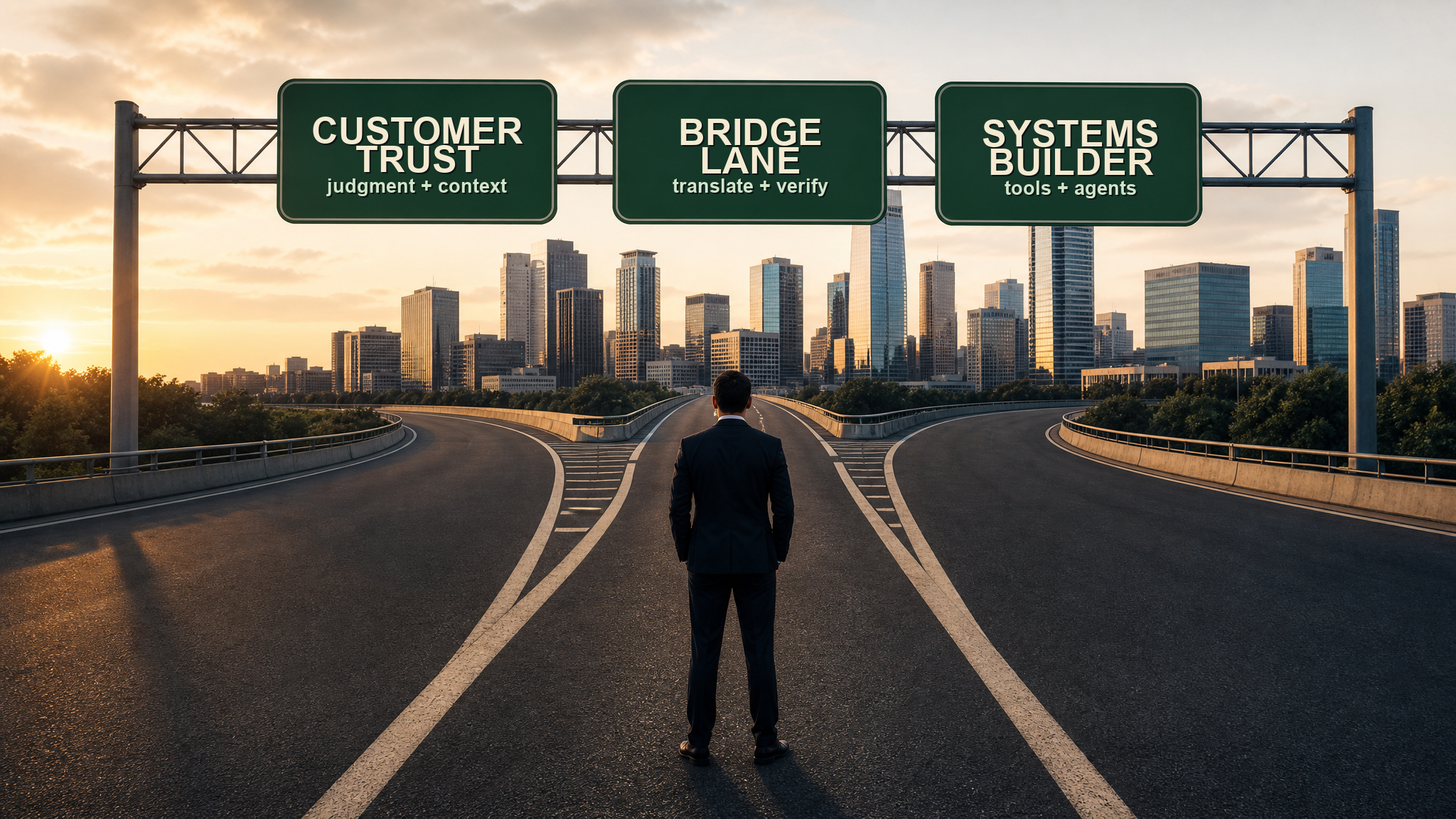
Maybe you are closest to the customer. Your value is judgment, trust, taste, and knowing what actually matters in the room.
Maybe you are closest to the system. Your value is turning messy work into a tool, agent, automation, or process someone can run more than once.
Maybe you sit between both. You understand the business well enough to define the outcome, and you understand AI well enough to help build or manage the system.
That middle lane is going to matter a lot.
Business owners have to see it too.
The question is not, "How many people tried ChatGPT?"
The question is, "What work still exists only because our old structure requires the handoff?"
Where is engineering getting pulled into things a trained operator could now prototype?
Where is a customer-facing person wasting time updating systems instead of talking to customers?
The builder and operator frame matters here.
Builders turn messy work into systems.
Operators own the outcome. They know the customer, the edge cases, the approvals, the trust, and the moment where a clean demo breaks in the real world.
One is not better than the other.
Both need AI.
The mistake is telling every operator to cosplay as an engineer. That is how companies end up with tool sprawl, abandoned automations, and agents nobody trusts.
The other mistake is letting "I am not technical" become a hiding place.
That door is closing.
The tools are making technical ability less about credentials and more about clarity.
Can you explain the outcome?
Can you describe the steps?
Can you tell the system what can change, what needs approval, and how you know the answer is right?
The future of work is not everyone becoming the same person.
It is people learning which lane they are in, and then using AI to make that lane sharper.
Playbook
Here is the simple map.
Pick one piece of work you touch every week.
Not your whole company. Not your whole job. One recurring piece of work.
Then ask three questions.
Am I closest to the customer?
Am I closest to the system?
Or am I the person connecting the two?
If you are closest to the customer, protect that lane. Use AI to clear the noise around you, but do not outsource the part where trust, context, or judgment matters.
Let the machine handle the notes, summaries, updates, drafts, research, and follow-up scaffolding.
Keep the human part human.
If you are closest to the system, get better at building useful things, not impressive demos.
Ask what starts the work, what data it needs, where it can act, what proof should come back, and how it fails on a messy Tuesday.
If you connect both sides, take that seriously.
You are the person who can translate business reality into something AI can help with.
For leaders, the exercise is just as simple.
Look at your team like a map.
Circle the people who own customer trust.
Circle the people who can build systems.
Circle the people who can translate between both.
Then look for the old handoffs that are starting to look silly.
The work is going to move there first.
Orientation
Do not turn this into an identity crisis.
It is a map.
Some days you build.
Some days you operate.
Some days you translate.
The danger is staying vague while the structure around you changes.
Block, Ramp, Stripe, and ClickUp are all pointing at the same thing from different angles. The companies moving fastest are not waiting for the job titles to settle. They are already rebuilding around people who can own outcomes, build systems, manage agents, and stay close to the customer.
If you missed my piece on the refactor period, this is the practical version of it.
The rebuild is happening when someone on your team who was "not technical" starts building the dashboard, tracker, assistant, or internal tool that makes their work faster.
The practical move is simple.
Know where you create value.
Learn enough AI to make that value sharper.
And learn how to work with the other lanes.
Comment below and tell me where you are right now: builder, operator, customer-facing, or somewhere in the messy middle.
I read every one.
— Brian